

They Don’t Make ’em Like they Used To

I offer you this toad because it is awesome and you could never make it with AI

We already know that Slack and email don’t make us better workers just by their nature. Used well, they can keep a distributed teams connected and focused. Used poorly, you could spend your whole day distracted and getting nothing meaningful done. Cal Newport’s Deep Work discusses this, along with many others.

This post is about how AI is making that landscape even worse.

Further Fractured Time

Generating AI documents takes time if you are asking for research, and a large output. I am using it to generate requirements for engineering, and also market research reports. I ask it to do something, and I might wait 1 – 15 minutes for the output. While I wait, I check Slack, I get a cup of tea, I start on a different project. I get pulled into something else, I have to join a meeting. So the output completes, and then sits for me to pick it back up later. Sometimes later is the following week. I don’t really know what this is doing to my psyche yet, but it feels like one more way in which work is becoming fractured, and it sometimes feels like we’re using our precious resources to generate all sorts of things that will just sit there and not be read.

Volume

I currently have multiple lengthy AI generated documents that have either been shared with me, or generated by me that are in my backlog to review. I have skimmed them, but they are so dense that I still want to go back and dig in. If I was really consuming them, then I would read every word, click on the links they created as references, comment on them to discuss a point with a colleague. In order to really do that I would probably need at least 2 full days with no distraction except my own need to move and eat. Since we live in a world of Slack, email, and meetings, I don’t know that I will ever be able to do this. Those documents sit in an open tab, or on my to do list. I could maybe get to one per week. This is not much different from before when all the information being out there on the internet or in books that I don’t have time to read.

Well-Being

We should start talking about how this is affecting our well-being. As aforementioned, we are already fractured, burning out, and multi-tasking when studies show that our brains are built to do one thing at a time. Here we are adding one more thing that distracts us, a thing going on in the background, a thing we are supposed to get to but we can’t.

Human in the Loop

The only answers to these problem if you’re starting with a premise that we have to use AI to go faster are: 1. trust the AI that it got everything right, or 2. ask AI to summarize the documents for you. Both of these are flawed approaches because AI is not trustworthy. It gets things mostly right, but there is a good 10 – 20% that it gets wrong. We argue that humans make mistakes too, but also, we specialize as humans so that we trust the information coming from a person who has spent years studying a given topic. We have started to specialize our AI agents. That could work for some things.

It could also lead us down some scary paths if we get to a point where we are just trusting the AI and never reviewing what it outputs. Every human (except the ones trying to profit off of this nonsense) thinks that we still need to be in the loop. And yet I hear more and more people talking about how much of the review we can automate and how little we maybe actually need the humans. This is coming from pressure to go fast and not pressure to make good things. Humans make good things. AI makes approximate things.

Maybe just as with manufacturing, we will start to accept lower and lower quality and just shake our heads and say they don’t make ’em like they used to.”

Job Security in the Time of AI

The layoffs are coming. “Experts” in the media are not sure yet what the impact will be, but they talk about it as if it could be anything from a nothing burger, to catastrophic.

At my company (which makes software and content), we have been using AI for a couple of years already on the content front. We would not create content without AI at this point. We have humans in the loop, but executives are asking us to push those limits. I have also personally worked on AI projects that have meant we didn’t have to hire as many contractors. That is not exactly a layoff, but it is a job that might have existed otherwise.

AI costs money. I assume that as with the cloud, we will figure out over time how to make this affordable to companies, how best to use our tokens, etc.. But there is no question in my mind that executives are already looking at the cost of AI, feeling the pressure to move to AI, and offsetting that cost by cutting the human chaff.

I have heard a few interviews now with Alex Bores (Ezra Klein, and Offline with Jon Favreau) who is running for Congress in NY and has some common sense ideas for AI regulation that we should be considering. An AI super PAC is trying to take him out. One of my main takeaways is that there are some pretty simple things we can do to protect the people against the billionaires and we need to be doing that right now.

Like the experts, I don’t know how bad it will get. What I am seeing is that there is still a need for humans and for expertise. But the people at the top, who don’t understand how any of this works, are hungry to get rid of the burden of employing so many humans. They will cut people, and cut people, those who still have jobs will become more and more miserable, and eventually there will need to be a re-balancing. Please, can we just stop it before it gets even worse.

Security

I listened to a podcast on digital surveillance and I have now changed my profile picture and name. In this environment, it is so easy for them to comb through everything and find out who you are an what you think. Our government is starting to hold what we think against us.

Facebook just started capturing all the data of what their employees are doing on their computers. There is no regulation. It’s a little scary to think that anything we type in here or anywhere else, except on a typewriter, can be found and tracked.

No, I am not paranoid. Nobody cares what I think right now. But if all of a sudden they started to care, if I was looking for a job and had to pretend I was all in on AI, or if the political environment gets even worse, then maybe I don’t want to be findable. I’m sure I haven’t thrown them entirely off my trail, but it might slow them down a little.

Day 1

This isn’t actually Day 1. We have been slogging through the depths of the AI revolution for over a year now. The days are long, the stress is real, and the dehumanization is, well, dehumanizing. This is the first day that I have decided to keep this log because I am now at least knee deep in it, and I would like to leave a trail in case I don’t come back out. What I have brought with me is a pencil, my sense of humor, my willingness to try, and my skepticism.

So, what is the landscape here on day 1? We are using these AI tools that some call agents to write requirements so that other agents can read them and produce software. The result right now is A LOT of text that we have to either choose to trust, or to read. I have chosen mostly to read, and every time I do, I find errors. Huge errors? Eggregious errors? Probably not.

All the reading is burning me out and slowly killing my soul. It means that I am interacting with a machine instead of with humans. If this is what Product Management will become, then I don’t think we will attract creative people. Our process has gone from the Agile methodology where we are very close with our teams and work quickly and iteratively, a process that values small chunks of bite sized work and iteration to huge chunks of text, and I assume code, where no human has read every word.

I haven’t yet seen the results. I was supposed to see results quickly. I suspect we’re doing it wrong, but how to convince my fellow travelers? It feels like we’re holding up a lantern in the dark and misunderstanding what we are seeing. I am searching for the light switch. I’ll let you know how that goes.
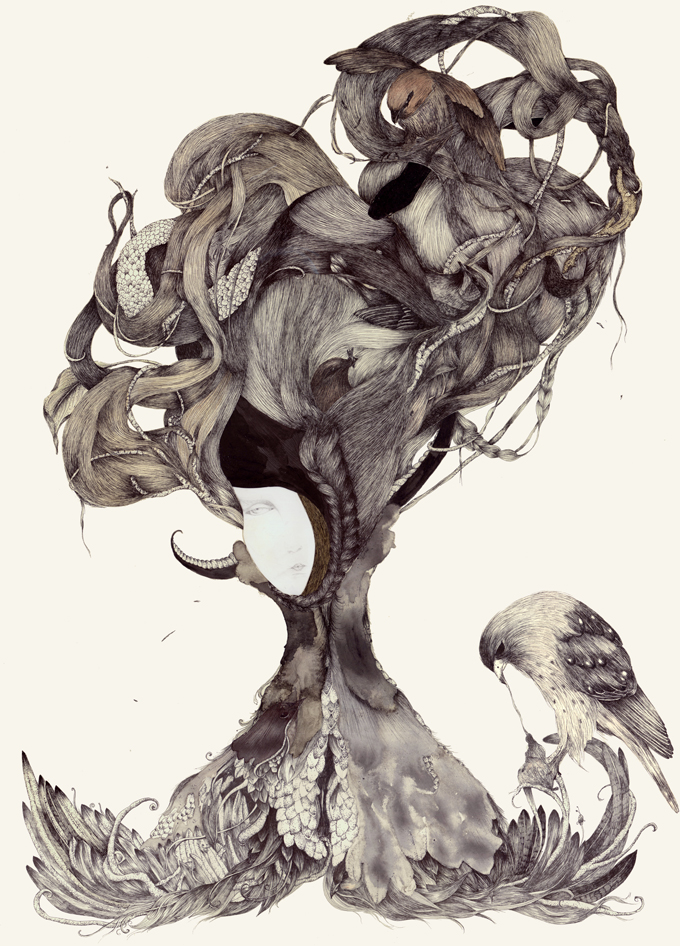
Erinyes


megaera
Art by Melissa Murillo

I often contemplate the end of the world as we know it: market crash, civil war, nuclear war, mass destruction caused by global warming.  It is a little embarrassing to admit, though I assume I am not alone.  It is not a far leap from where we are today, if you’re paying attention.

I wonder: should I be planning for this? buying guns? stockpiling food and water? building a bunker?  The billionaires are building bunkers and buying land in remote areas (1).   Will we later wish we had prepared for the worst instead of saving for a retirement that will never happen?

Assuming we don’t build a bunker, I wonder what my family would do in the case of disaster.   In some of my imaginings, we die.  In others, we are on the move, running to who knows where and from who knows what. In still others, our community comes together and helps one another.

These musings remind me to appreciate the things I have while I have them:  a warm and comfortable house, good food that is easy to buy, clean running water.  How convenient our phones, computers, connectedness.  How lucky we are to have our health and  healthcare.  How far a fall it would be from this to nothing.

Then I remember how quaint (read enraging) these musings might be to the 60+ million people in the world who are in that very situation (2).  Of course, I can’t pretend to know how they are feeling.  Their world has collapsed.  They have lost friends and family members. They have lost their homes, their cities, their countries, their livelihood.  They have next to nothing.  They are living the collapse I only imagine in horror.

Then I remember those billionaires building bunkers who could instead be building housing, or creating jobs.

Then I give money to UNICEF or the International Rescue Committee and I hope that it helps … but I know that it is not enough.